
Dubai Police Safety Rating Hits an Impressive 99.9% in 2025
The latest Dubai Police safety rating is about as close to perfect as it gets: 99.9% of people surveyed felt safe during the day in 2025, and 99.1% felt safe in public places at night. The results were reviewed by Lieutenant General Abdulla Khalifa Al Marri, Commander-in-Chief of Dubai Police, during his annual inspection of...
The latest Dubai Police safety rating is about as close to perfect as it gets: 99.9% of people surveyed felt safe during the day in 2025, and 99.1% felt safe in public places at night. The results were reviewed by Lieutenant General Abdulla Khalifa Al Marri, Commander-in-Chief of Dubai Police, during his annual inspection of the force’s General Department of Excellence and Pioneering, alongside a 40% cut in administrative procedures and a new strategy running to 2033.
For anyone who lives in the city, the headline number probably won’t come as a surprise. What’s more interesting is what’s happening behind the scenes to keep it there.
Breaking Down the Numbers
The two key figures measure how safe people feel, by day and by night:
| Indicator (2025) | Result |
|---|---|
| Feel safe during the day | 99.9% |
| Feel safe in public places at night | 99.1% |
The daytime result isn’t new information, but it’s an important one. It first came out in July, as part of the national Security Quality of Life Survey carried out by the Federal Competitiveness and Statistics Centre with the Ministry of Interior. That same survey gave Dubai Police 98.2% on its overall security quality of life index and 96.2% for public confidence in police stations.
On top of the survey results, Dubai Police also received an AAA+ rating in 2025, ranking it as the world’s strongest police brand. It’s a sign that the force’s reputation now travels well beyond the UAE.
Safety Perception Rating in Dubai
Daytime
99.9%Night-time
99.1% https://t.co/bZgHjvRsFw— Dubai Media Office (@DXBMediaOffice) November 15, 2026
Less Paperwork, More Policing
The safety scores grab the headlines, but some of the most striking figures from the inspection are about how the force runs itself. Administrative procedures across Dubai Police’s organisational units have dropped from 2,791 to 1,670, a reduction of 40%.
The number of organisational performance indicators has also been trimmed by 22%, from 2,777 to 2,164, leaving teams with fewer measures to manage. Meanwhile, the force reports a 25% improvement in its organisational structures between July 2024 and 2026.
In practical terms, the goal is a leaner, more flexible organisation: fewer internal steps, quicker decisions and resources that can be moved to where they’re needed most.
A Decade of Smart Policing
The inspection also looked back at the force’s achievements from 2017 to 2026, a period in which technology became central to how Dubai is policed. Among the projects reviewed:
- Smart Police Stations: the first opened at City Walk in 2017, offering police services without the need to deal with an officer in person, and the concept has since been upgraded with agentic AI.
- Oyoon: the force’s AI-supported camera and security project.
- eCrime: the online platform for reporting cybercrime.
- Drone Box and Ghiath Smart Patrol: drones and smart patrol vehicles that help officers respond faster and cover more ground.
- SAS: an interactive data analysis system, alongside wider security analytics tools.
The review also highlighted the UAE SWAT Challenge and the World Police Summit, two events hosted in Dubai that bring law enforcement agencies from around the world together to share expertise.
What Comes Next: The Road to 2033
Looking ahead, the department presented its strategy for 2026 to 2033. It rests on four pillars: flexible strategic planning, institutional excellence, building specialised talent, and continuous learning through international partnerships.
Artificial intelligence already plays a growing role behind the scenes. The department uses AI tools to analyse performance indicators, draft reports and recommendations, review administrative procedures and forecast future performance. New digital platforms are also planned for global benchmarking, policy management and the running of councils, committees and working groups.
Al Marri urged his teams to keep turning creative ideas into practical, proactive projects, to learn from the best international practice, and to keep investing in both technology and people. He closed the inspection by honouring several members of the department for their contributions.


More from Government & Politics
 Government & Politics
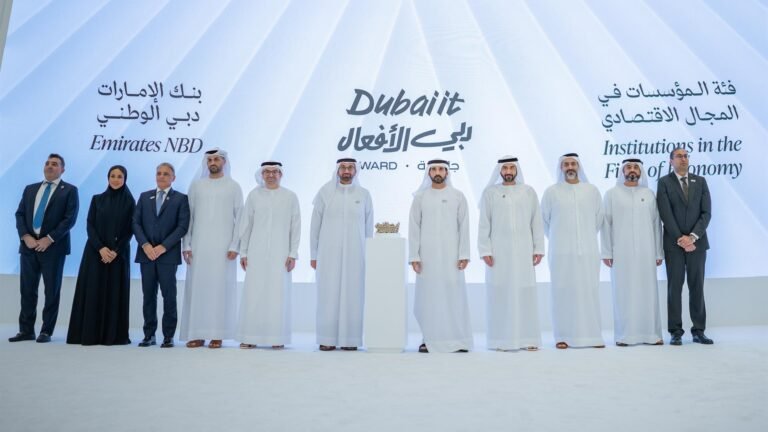
Dubai-it Award 2026: Sheikh Hamdan Honours 13 Winners
Sheikh Hamdan bin Mohammed bin Rashid Al Maktoum, Crown Prince of Dubai, honoured 13 winners of…
 Government & Politics
UAE National Day 2026: Eid Al Etihad Holiday Dates Confirmed
The UAE is getting ready to mark its 55th Eid Al Etihad, and the federal government…
 Government & Politics
Dubai Police Competition: 5 Lucky Winners to Get Esaad Cards
A new Dubai Police competition is giving residents the chance to win something most people can’t…